
In early December, I found myself back in Iowa for the 57th annual Iowa Track & Field / Cross Country Coaches Clinic. If you’ve ever attended this clinic, you know it’s not just an event—it’s a tradition. One built on decades of showing up, asking better questions, and choosing growth even when the season is long and the job is demanding.
And in my line of work, I get to see this same thing happen in state after state … “…from sea to shining sea” every coaches clinic is sacred time to gather and grow.
The Iowa clinic was hosted, as it has been for years, by Darryl Bennett and his incredible team at Championship Productions. Their ability to create a space that honors both performance and humanity is no small feat. It’s part logistics, part leadership, and part care—and it shows.
As always, I left Iowa with pages of notes, a full heart, and a deeper appreciation for the coaches who walk into rooms like this one year after year.
Across the Aisle: Books and Uniforms, Purpose and Craft
This year, something unexpected happened.
Our Blue Star booth—filled with American-made, fully custom sublimated singlets—was set up directly across the aisle from Jerry Lynch. On one side: books on leadership, culture, and the inner life of champions. On the other: uniforms designed to carry a team’s identity onto the course.
It felt symbolic.
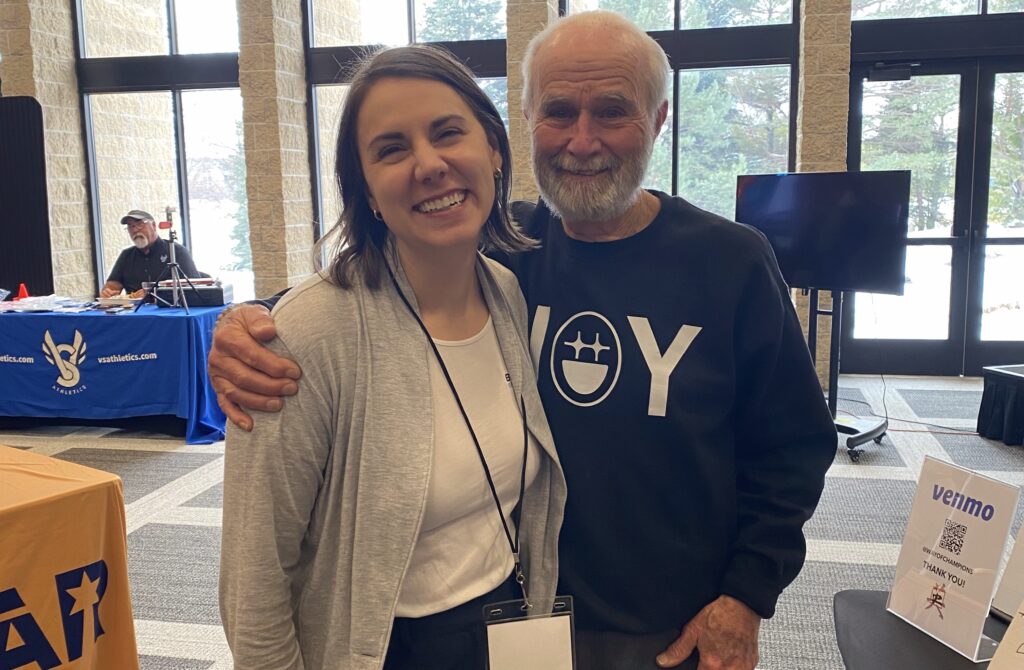
Jerry Lynch is the founder of Way of Champions and has worked with over 130 national and world championship teams—Duke, Stanford, UConn, UNC, the Golden State Warriors, and so many more. I had the opportunity not only to hear him speak, but to talk with him one-on-one throughout the weekend as coaches drifted between his books and our gear.
And here’s what struck me: the conversations happening at both booths weren’t about winning at all costs. They were about meaning. About identity. About what kind of leader you become when no one is watching.
Turning Feelings Into Function
In his talk, Jerry broke down the Way of Champions—a framework centered on athletes and coaches who learn to turn feelings into function. Not suppressing emotion. Not denying pressure. But transforming it.
He spoke about showing up to compete, not just to win.
That distinction matters. Winning is an outcome. Competing is a choice you make every day—in how you train, how you communicate, how you recover from mistakes, and how you model resilience for your athletes.
Jerry shared slide after slide of insights that applied just as much to life as they did to sport. But one moment landed especially hard.
In a room that was roughly 80% men, he said—without hesitation—that coaches must love their athletes. Truly love them.
Not coddle. Not rescue. Love.
In his words:
“If you want to teach them, you must reach them.”
That takes courage. And clarity. And a willingness to lead with something deeper than ego.
The Question That Stayed With Me
Now a little known fact: when coaches are in session listening to speakers and leveling up their skills, vendors chat with one another. Some of us are competitors sure, but most of love sports and love talking shop.
So of course, when the coaches moved into another conference hall and the exhibit area was quiet, I asked Jerry, “When did you know you were living your true purpose?”
He paused. And then said, “About age 62.”
Let that sink in.
After decades of coaching, consulting, winning championships, and writing books (hello #SUCCESS), it wasn’t until then that he felt he had truly let go of his ego enough to embody what he had been teaching all along.
He talked about how knowing something intellectually is different than living it. How achievement can sometimes delay embodiment. How purpose often requires us to shed who we thought we needed to be in order to fully become who we are.
It was honest. And humbling. And deeply human.
Coaches, I Want to Ask You Something
As I drove home from Iowa, I kept thinking about the coaches I met. The ones asking thoughtful questions. The ones quietly taking notes. The ones returning year after year, not because it’s required, but because growth still matters to them.
So I want to ask you a few questions, not to answer here, but to sit with:
- What part of your coaching identity feels fully embodied right now—and what part still feels performative?
- Are you showing up to win, or are you showing up to compete—to be present, intentional, and grounded in your values?
- If your athletes modeled leadership the way you do, would you be proud of what they became?
- And perhaps the hardest one: where is ego still driving the bus in your coaching journey?
These aren’t questions with quick answers. But they are the questions that separate good coaches from transformative ones.
Why This Matters to Us at Blue Star
At Blue Star Sports Apparel, we don’t just make uniforms. We work with coaches who are building cultures—often quietly, often without recognition, often in ways that will never show up on a scoreboard.
When we design a track or cross country uniform, we’re not thinking only about performance. We’re thinking about identity. About how an athlete feels pulling that singlet over their head. About what it represents when they line up next to their teammates.
We are a second-generation, woman-owned company. Every sublimated singlet and short we make is produced in America. That choice is intentional—because legacy, craftsmanship, and integrity matter to us. And because we know they matter to you, too.
I left Iowa reminded that the best coaches are never finished. They’re still becoming. Still refining. Still asking who they are beneath the role.
If that’s you—if you see coaching as a calling, not just a job—know this: We see you. And we’re honored to outfit the journey.
Ready to build a unified look that matches your program’s values? Click here to request a free design mockup and clear package quote.